
Orvedis AI
The assistant that read the manual.
Grounded in your vessel’s own equipment. It explains and diagnoses; never instructs dangerous work.
Structure, not a wall of text.
Cards, steps and checklists — each one answerable with a tap.
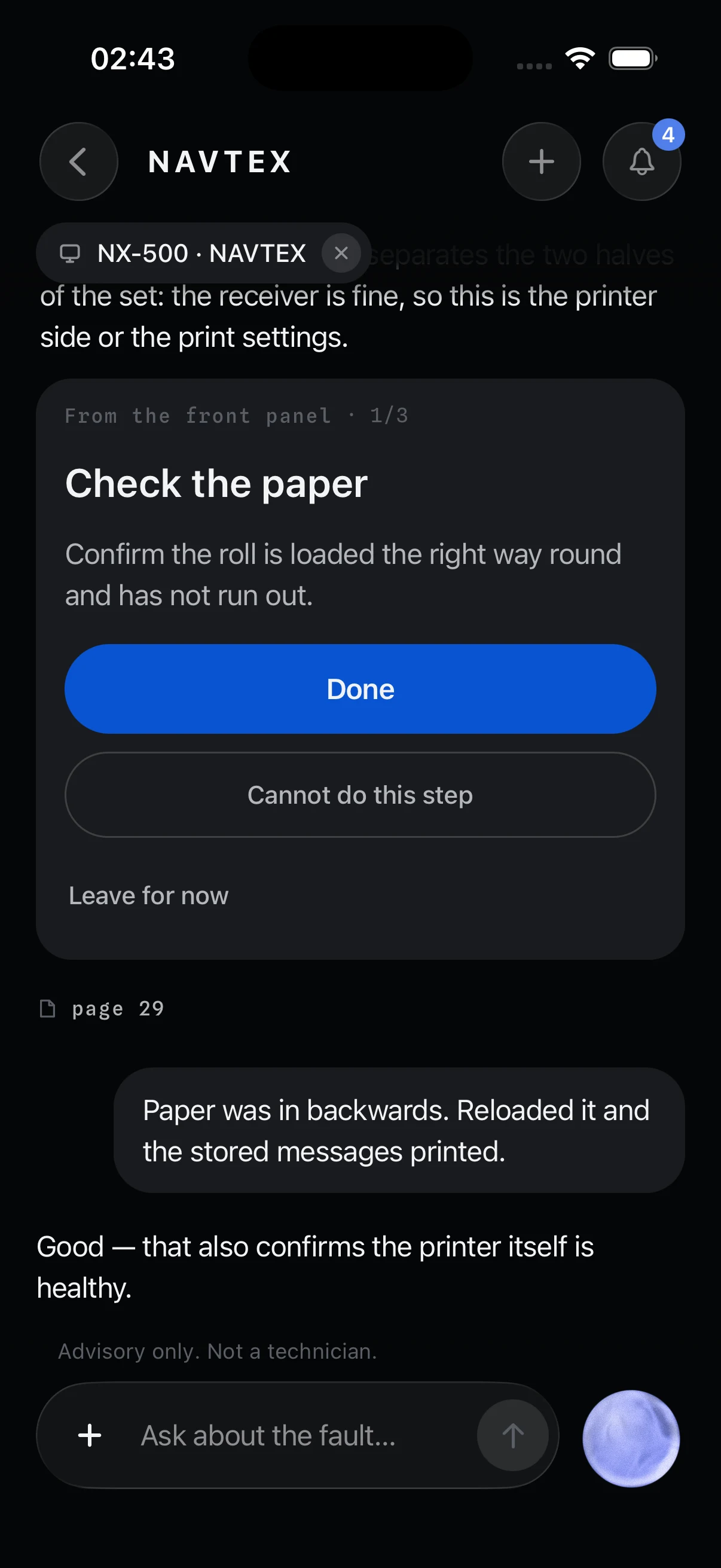
Four faults. Four honest endings.
Cleared, reported, understood, referred — the assistant says which, and why.
-
Cleared on the bridge.
Mutual interference from a radar nearby; the IR levels, one at a time, from outside the set.
-
Report sent in one tap.
DSC settings, the test channel, STBY or TX — checks marked as made; what is left goes with the report.
-
Understood: the licence, not the update.
Permit, licensed areas and update media, from page 212; the office had already sent a new permit.
-
Referred to a specialist.
What FAULT means on this model and what the manual ties it to — and where the work stops being the crew’s.
Illustrative cases on a demonstration vessel.
Speak. It proposes. You confirm.
Voice is a layer over the same cards. A spoken yes writes nothing.
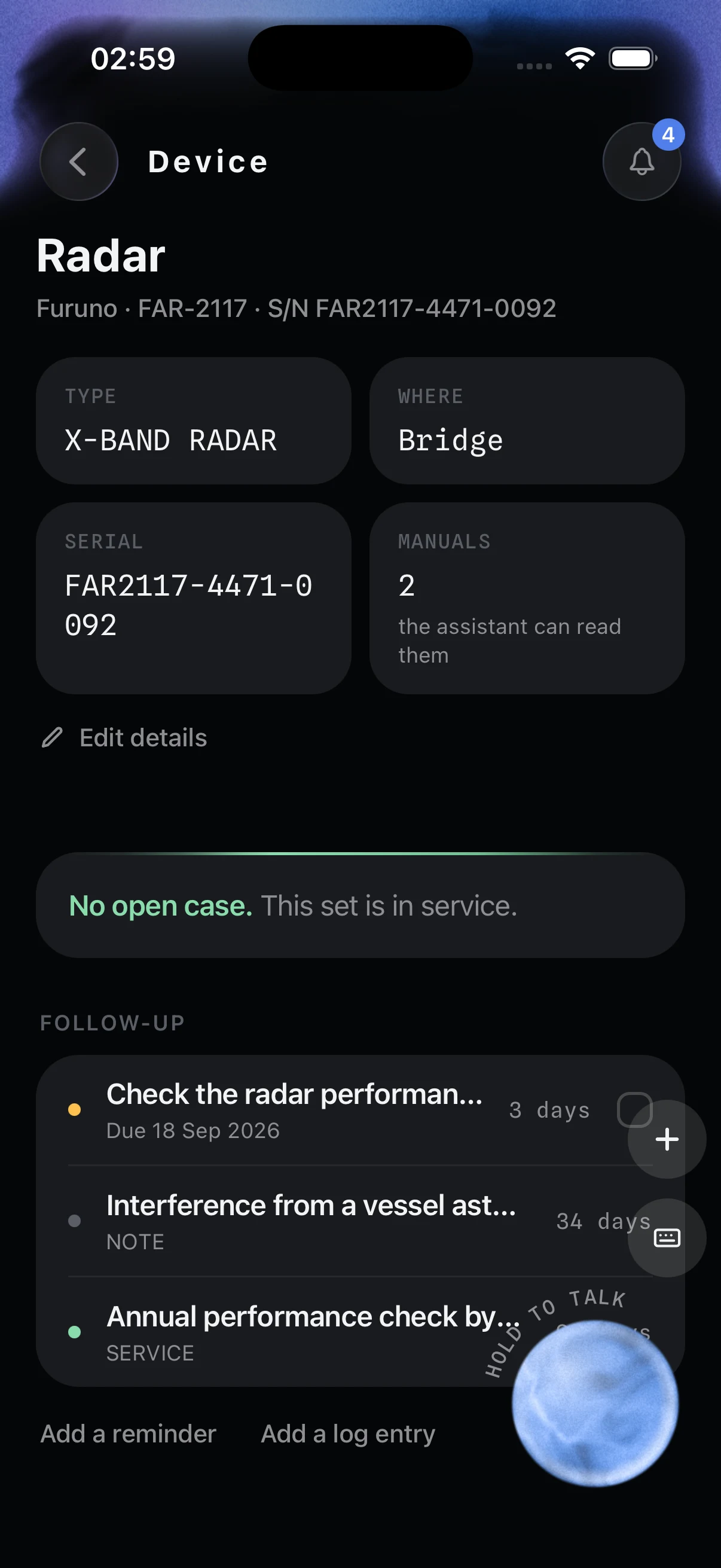
The report a technician can use.
What was seen, checked, not checked and still open — before boarding.
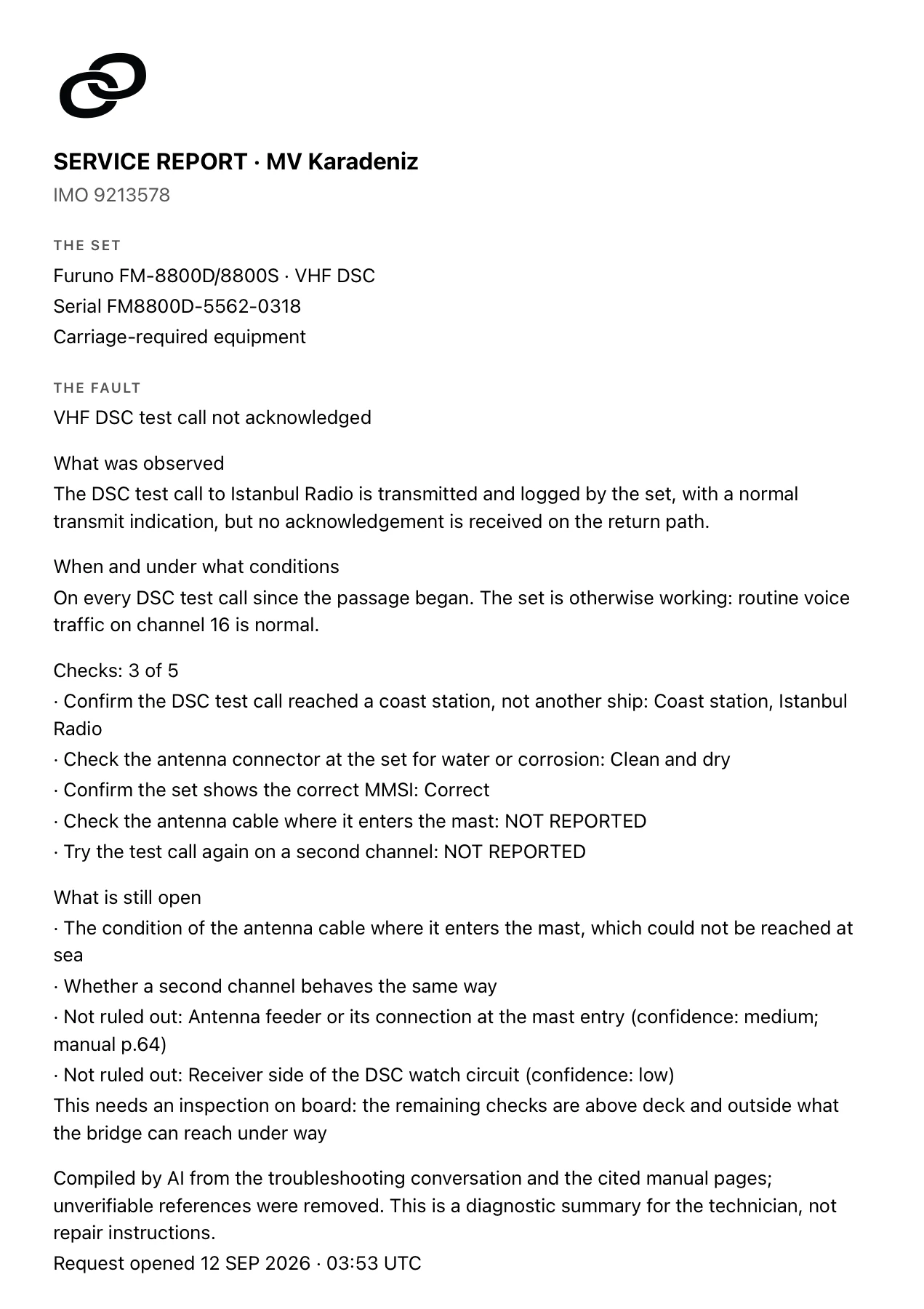
Lessons from the manual’s chapters.
Device training for new crew: each lesson is a chapter of the set’s manual.
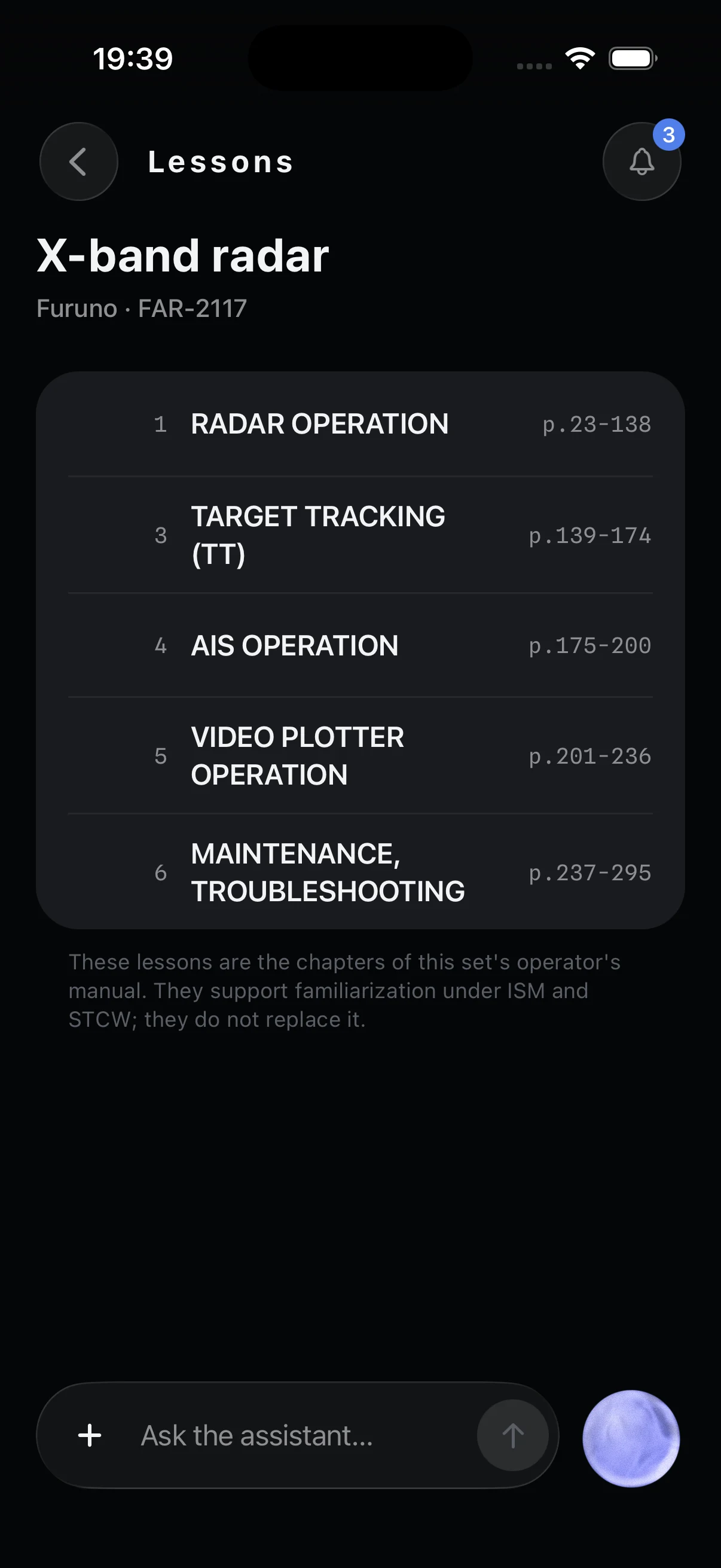
Numbers are the manual’s own chapter numbers; the installation chapter is not a lesson.
Where it stops. In every mode.
These it never guides, even when the manual contains the steps.
- Opening the case
- High voltage, capacitors
- Antenna or sensor alignment and calibration
- Soldering, internal parts
- Firmware and software updates
- Anything a wrong move could damage or that could injure someone
Regulatory questions get the status and the duty — never permission. Your fleet’s data is scoped to your organisation; cross-organisation access is tested on every release.
Questions we get asked.
Which equipment does it cover?
Electronic navigation and communication equipment: radar, ECDIS, compasses, autopilot, logs, GPS/AIS, VHF/MF-HF, NAVTEX, Inmarsat, VSAT, SSAS/EPIRB/SART, VDR. Engine room and deck machinery are a later, deliberate step.
Where do the answers come from?
From the manuals attached to that set in your vessel’s record, retrieved passage by passage and cited by page. Not from the open internet, and never from another organisation’s data.
What if a set has no manual attached?
The assistant says so and does not improvise from general knowledge. It offers to open a report instead. Our demonstration vessel keeps one radar without a manual on purpose, so this behaviour is tested every time.
Can it tell us to open the unit or adjust the antenna?
No, in any mode. Opening the case, high voltage, alignment or calibration, soldering, internal parts and firmware are never guided, even when the manual contains the steps. It stops and points to the report.
What does “fail-closed” mean?
Before an answer reaches the crew, code scans it. If it crosses the safety line, the whole answer is dropped — not edited — and a fixed notice takes its place. The rule lives in code, not in a prompt.
Can it say whether we may sail?
No. It states the equipment’s regulatory status and the duty that follows — log it, inform the master — and never grants permission. Sailing decisions belong to the master, the company and the flag.
Does a spoken “yes” confirm anything?
No. Voice can propose a check; only a tap on the screen records it, marks it or sends anything. Nothing is written without your finger.
Who sees our data?
Only your organisation. Every query, retrieval and record is scoped to the organisation on the signed-in account, and that boundary has its own tests on every release. Orvedis does not use your manuals or conversations to train models.
Next step
See it on your equipment.
Thirty minutes, your equipment list, your questions.
Request a demoWe reply within one working day.